A few recent robotics deals have made me think more about one thing: robot form factor.
Are humanoids actually useful? And is making robots look more like humans really the right goal, or does it sometimes just make them look more impressive?
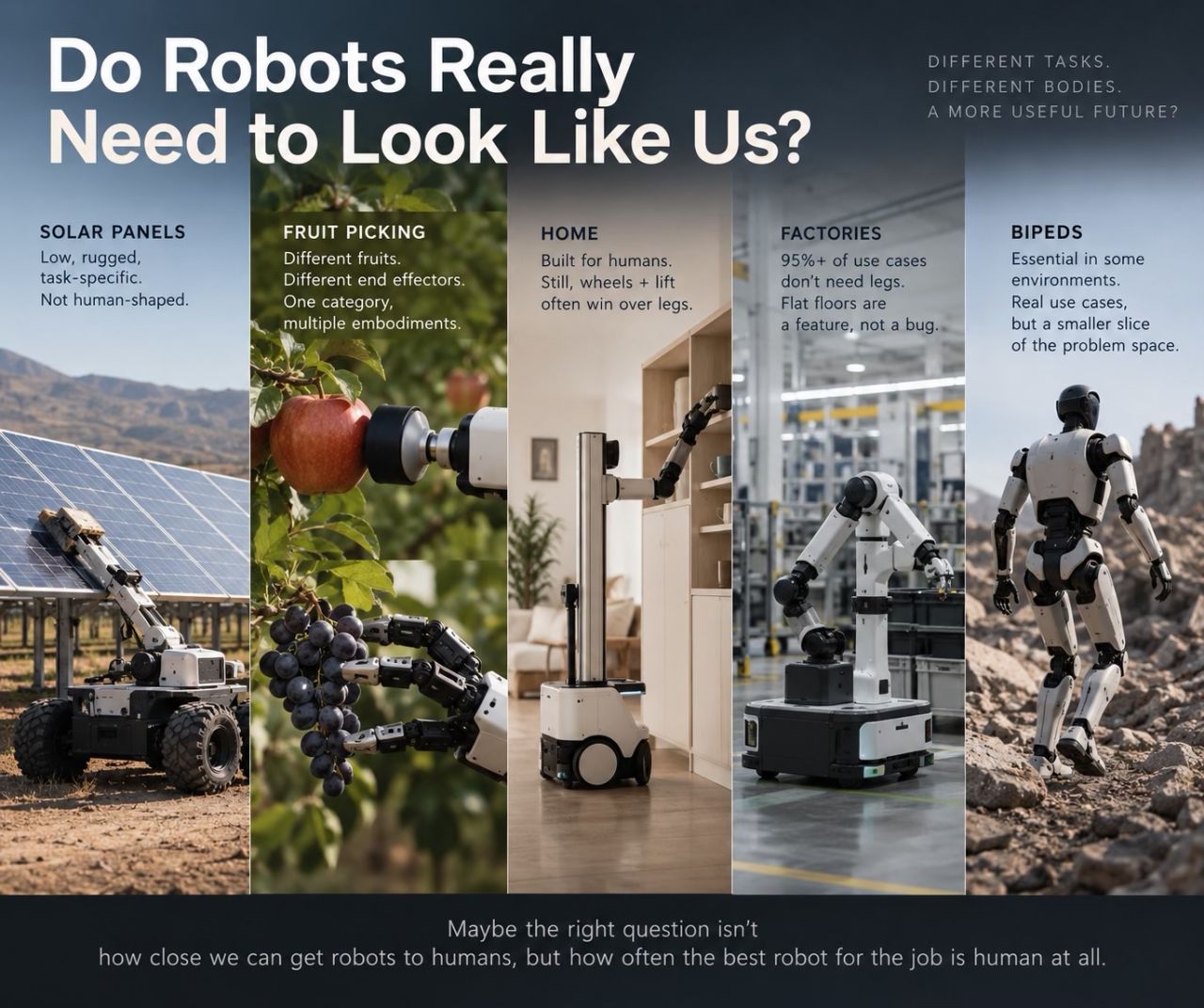
Take solar panel maintenance. Humans do the work today, but the optimal machine would probably have a very low chassis + off-road wheels, simply because of the panel height, spacing, and terrain.
Humans are there because, for now, there isn’t something better. That doesn’t mean the robot replacing them should look human.
Or take fruit picking.
🍎 Apples can use suction cups.
🍇 Grapes may need dexterous hands.
The difference isn’t technological sophistication. It’s the fruit itself: apples are rigid and regular; grapes are soft, clustered, fragile, and attached by stems.
Change one fruit and the optimal end effector changes. Even “fruit picking” may be too broad for one general-purpose solution.
The home should be the strongest case for humanoids. Our homes are literally built around human dimensions. Yet even here, we’re seeing robots use wheels + vertical lifts instead of legs.
Factories are even more straightforward. Someone from Siemens told me 95%+ of factory use cases don’t need legs. Factory floors are already flat.
So in two of the most anticipated markets for humanoids, home and industrial, the answer still seems to point toward wheels.
Then there’s Unitree. In the first three quarters of 2025, 73.6% of its humanoid revenue came from research and education. Industry applications were only 9%, and 50 to 70% of that was enterprise reception and guided tours.
So today, two of the clearest use cases for bipeds are: being researched, and being watched.
Both are real demand. Both make money. But neither is really about doing work.
So where are two legs actually irreplaceable? Disaster zones? Outdoor inspection? Old buildings with stairs?
These are real use cases. But they start to feel more like a SKU than a direction.
Meanwhile, enormous engineering effort goes into running, backflips, boxing, and balance. These are extremely hard control problems, and the engineering deserves respect.
But they prove balance, not work. And balance happens to be one of the most camera-friendly capabilities a robot can have.
Maybe the right question isn’t “What jobs can we make a humanoid do?” It’s “If we designed the cheapest, simplest, most reliable machine for this job from scratch, would it still look human?”
Because “more human-like” and “more useful” may be two very different optimization targets.